
Irish Lights’ Offshore Estate at the Centre of New Research on Biodiversity and Climate Resilience
21 April 2026:
A new EPA‑funded research initiative, Leveraging Island LiGhthouses and Harnessing Technology to examine Heritage Opportunities in Unique offShore Environments (LIGHTHOUSE), has been launched at Irish Lights Headquarters, Dublin on 21 April. This is a unique project internationally, and its objective is to improve knowledge about island biodiversity, climate, habitat and ecosystems and to monitor the impact of the withdrawal from surplus lighthouse infrastructure. Building on Irish Lights’ long-standing stewardship of these remote sites, the project will explore how lighthouse infrastructure can support positive national sustainability and biodiversity goals.
Announcing the project, Roni Hawe, Director of the Office of Evidence and Assessment at the EPA, said: “Ireland’s ecosystems are facing significant pressures, from climate change, pollution and other environmental factors. Offshore islands are among our most fragile ecosystems, and the EPA-funded LIGHTHOUSE project will provide the scientific foundation needed to protect biodiversity, understand environmental change and guide sustainable decision‑making for years to come.”
LIGHTHOUSE is a four‑year collaborative project involving Mary Immaculate College, Queen’s University Belfast, University College Dublin, the National Parks and Wildlife Service and Irish Lights, whose offshore estate forms the core study area for the research. The project is funded under the EPA research theme Implementing effective ‘protect and restore’ solutions, with external advisory support from University of Limerick, University College London and the University of Exeter.
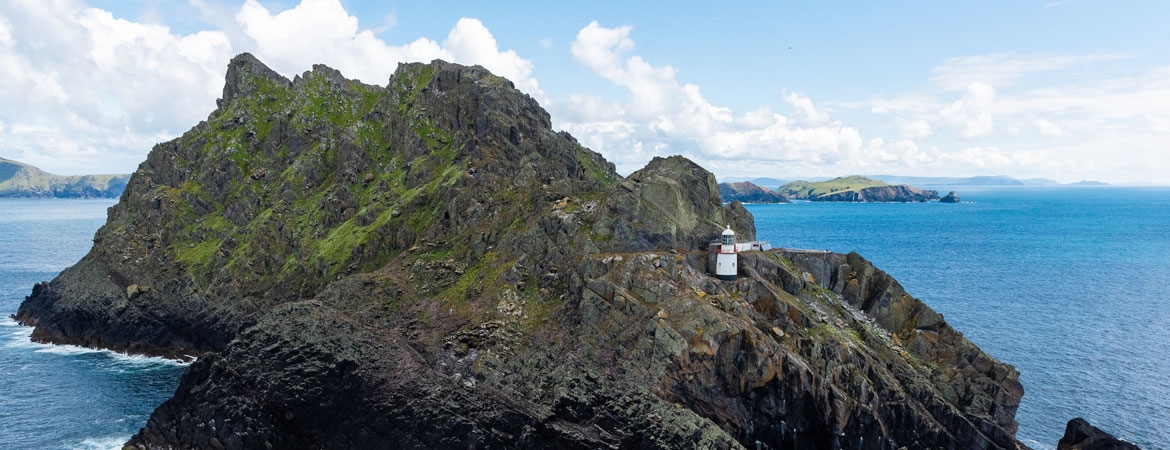
Led by Mary Immaculate College, the project integrates cutting‑edge geospatial mapping, seabird monitoring and innovative approaches to study six of Ireland’s most remote and ecologically significant uninhabited islands. These islands, all of which are owned by Irish Lights, support globally important seabird populations and provide unparalleled natural observatories for detecting environmental change.
Speaking about Irish Lights’ role, Yvonne Shields O’Connor, CEO said: “Irish Lights has a long and continuous history of stewardship on these offshore islands. As we responsibly withdraw from surplus infrastructure, such as former dwellings and stores buildings, it is important to note that the Aids to Navigation on these sites will remain fully operational. These assets including lighthouse towers are essential for the safety of navigation at sea, the core mission of Irish Lights. The LIGHTHOUSE research project aligns strongly with our sustainability commitments and will help shape best practice for managing our offshore estate and navigation assets in a way that supports positive biodiversity outcomes.”
The LIGHTHOUSE project will examine how historic buildings and ancillary structures can be transitioned into nature‑positive spaces, supporting Ireland’s commitment to protect 30% of its marine environment by 2030. The research will generate essential baseline geospatial, heritage and biodiversity datasets, while piloting new conservation approaches suited to remote island environments.
Research will focus on six Irish Lights properties: Bull Rock, Inishtrahull, Inishtearaght, Mew Island, Rockabill and Slyne Head. These islands host globally important seabird populations and provide natural observatories for detecting environmental change.
Professor Catherine Dalton, Project Lead at Mary Immaculate College, highlighted the scientific opportunity: “These offshore islands are among Ireland’s last truly wild places. By mapping them in detail and reimagining lighthouse heritage for nature, we can better protect their biodiversity and understand how they’re responding to a changing climate.”
The LIGHTHOUSE project will contribute to evidence‑based planning for, enhanced understanding of biodiversity and habitat resilience on remote islands, national priorities on Marine Protected Areas and biodiversity recovery, the adaptive reuse of lighthouse infrastructure to support natural habitats and international knowledge sharing through bodies such as IALA (International Organisation for Marine Aids to Navigation).
Speaking at the launch Niall Ó Donnchú, Director General, National Parks and Wildlife Services (NPWS), said: “These islands are jewels of our natural heritage, wild, remote and ecologically irreplaceable. As we work to restore nature and expand Ireland’s network of Marine Protected Areas, LIGHTHOUSE offers an invaluable opportunity to deepen our understanding of these habitats and ensure that any changes to operational lighthouse infrastructure enhance, rather than diminish, their ecological significance.”
ENDS
For further information contact:
Jane McGahern, Communications Manager, Irish Lights - jane.mcgahern@irishlights.ie
087 275 8967
Notes to Editor:
EPA Research
The LIGHTHOUSE Project (Grant: 2025-NE-1297) is supported as part of the EPA Research Programme 2021–2030. The EPA Research Programme is a Government of Ireland initiative funded by the Department of Climate, Energy and the Environment. It is administered by the Environmental Protection Agency, which has the statutory function of co-ordinating and promoting environmental research.